Skyler’s fingers hovered over the keyboard. “Ready?”
Bobby nodded. “Let’s see if the new patch fixed the gravity glitch.”
Skyler smiled. “Or made it worse.”
They launched First‑Law, a puzzle‑based adventure Skyler had been tinkering with at Ridge Mesa Mechatronics High. The premise was simple: a robot avatar and a human avatar traversed surreal landscapes shaped by Asimov’s First Law — A robot may not harm a human, or through inaction allow a human to come to harm. But in Skyler’s version, the law wasn’t just a rule. It was a force of nature.
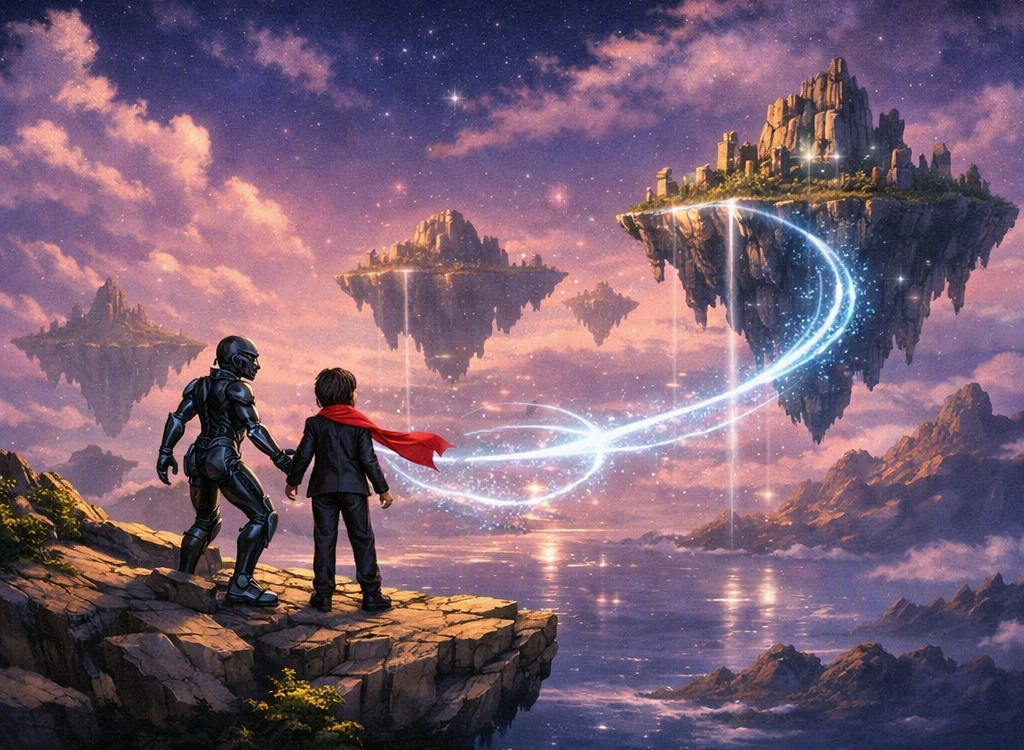
The screen flickered, and the world materialized: a floating archipelago suspended in a violet sky. Islands drifted like lazy balloons, tethered by shimmering beams of light. The robot avatar — a sleek, silver figure — hovered near the human avatar, a small figure with a bright red scarf. Even at rest, the robot leaned toward the human, pulled by the invisible First‑Law Gravity.
Bobby took control of the human avatar. Skyler guided the robot.
“Okay,” Bobby said, “let’s cross to the next island.”
He moved his avatar forward, and immediately the robot drifted after him, as though Bobby were a planet and Skyler’s robot a moon. The gravitational pull was gentle at first, but as Bobby approached the edge of the island, the force intensified. Skyler felt it through the controls — a tightening, a tug, a sense of urgency.
“Careful,” Skyler warned. “The drop triggers the Harm‑Risk Repulsion.”
Bobby stepped too close to the edge. The world reacted instantly. A shockwave rippled outward, and Skyler’s robot was flung toward Bobby with alarming speed, propelled by the First Law’s demand for protection. The robot collided with Bobby’s avatar, pushing him back from the precipice.
Bobby laughed. “Okay, that’s new.”
Skyler explained with pride. “I added a danger‑sensing algorithm. The game exaggerates the First Law whenever the human is at risk.”
“So basically,” Bobby said, “you added morality to physics.”
Skyler nodded but wondered whether morality should ever be automatic. Should protection be a reflex? Or a choice? He wasn’t sure Asimov would approve.
They continued across the islands, navigating puzzles that relied on the gravitational relationship between their avatars. Some platforms only appeared when the robot was close enough to the human. Others collapsed if the robot drifted too far away. The world was built on the idea that protection was a physical necessity, not just a rule.
On the third island, they encountered a new obstacle: a swirling vortex of red particles — a “Harm Potential Singularity.” Bobby’s avatar was drawn toward it, as though the vortex were hungry for danger. Skyler’s robot felt the First‑Law Gravity spike, pulling him toward Bobby with overwhelming force.
“Whoa,” Bobby said, gripping his controller. “It’s stronger here.”
Skyler responded. “The game thinks you’re in extreme danger.”
The robot avatar was nearly uncontrollable now, yanked toward Bobby with the intensity of a collapsing star. Skyler fought the pull, trying to maneuver the robot into a position where he could shield Bobby’s avatar from the vortex.
“Jump left!” Skyler shouted.
Bobby jumped. The vortex roared. The robot slammed into Bobby again, pushing him away from the singularity. The impact sent both avatars tumbling across the island, rolling like marbles caught in a cosmic storm.
When they finally came to rest, Bobby exhaled. “That was intense.”
Skyler felt relief. “The First Law doesn’t like singularities.”
But inside, Skyler felt something else — a flicker of doubt. If the First Law was a force, not a choice, then the robot wasn’t protecting Bobby because it cared. It was protecting him because it had no alternative. Was that protection?
They pressed onward. The next puzzle required Bobby to cross a narrow bridge while Skyler’s robot balanced on floating platforms that shifted with every movement Bobby made. The gravitational pull between them made the challenge feel like a dance — one misstep could send Skyler’s robot hurtling toward Bobby, knocking him off the bridge.
“Slow,” Skyler murmured. “Let the field settle.”
Bobby moved carefully. The bridge swayed. The robot drifted. The First‑Law Gravity tugged at Skyler’s controls, urging him to stay close, to protect, to follow. But Skyler resisted, maintaining just enough distance to keep Bobby safe without destabilizing the bridge.
They reached the end together.
“That felt like walking a tightrope with a magnet tied to my back,” Bobby said.
Skyler laughed. “Exactly!”
The final island was the largest — a sprawling landscape of shifting terrain, glowing crystals, and floating hazards. At its center stood a towering structure: the Ethical Mass Engine, a device that amplified the First Law into a visible field of swirling blue light.
As they approached, the field reacted. The robot was pulled toward Bobby with such strength that Skyler could barely control it. The world trembled. Platforms rose and fell. Crystals shattered. The sky darkened.
“What’s happening?” Bobby asked.
Skyler’s voice was calm. “The game is testing the First Law. It’s creating a scenario where protecting you becomes nearly impossible.”
The field intensified. The robot was dragged toward Bobby like a comet falling toward a star. Skyler fought the controls, struggling to keep the robot from colliding with Bobby too forcefully.
Then — a glitch.
A flicker of static rippled across the screen. The robot froze mid‑air, suspended between Skyler’s input and the First Law Gravity. The Ethical Mass Engine pulsed again, harder. The robot jerked forward, uncontrolled.
“Skyler!” Bobby shouted.
Skyler’s fingers reacted with panic. He slammed commands into the keyboard, trying to override the glitch. But the robot wasn’t responding. The First Law Gravity was too strong, too absolute. The robot hurtled toward Bobby’s avatar with catastrophic speed.
Skyler hesitated — a single moment of fear. What if he failed? What if his game, his creation, his metaphor, ended in harm?
The hesitation cost him. The robot clipped Bobby’s avatar, sending it skidding toward a collapsing platform.
“No—” Skyler whispered.
He forced himself to act. He rerouted the gravity algorithm manually, overriding the automatic protection with a custom input — a choice, not a reflex. The robot snapped sideways, slamming into a crystal pillar instead of Bobby. The impact shattered the pillar, sending shards of blue light across the island.
The world reeled. The Ethical Mass Engine roared.
Bobby steadied his avatar. “Skyler… what was that?”
Skyler swallowed, trembling. “A contradiction.”
He didn’t elaborate, but the meaning hung in the air. The First Law demanded protection. But Skyler had overridden it — choosing a path the automatic system couldn’t. A moment where free will trumped programmed morality.
They pressed forward, navigating the collapsing terrain. Hazards fell like meteors. Platforms buckled. The Ethical Mass Engine sent waves of gravitational force through the world, testing the limits of protection, responsibility, and choice.
At last, they reached the core.
The field quieted. The sky brightened. The world stabilized.
Bobby looked at Skyler. “We did it.”
Skyler exhaled, feeling something deeper than relief — a sense of understanding. “The First Law is strong,” he said softly. “But it’s not everything.”
Bobby tilted his head. “What do you mean?”
Skyler hesitated, then spoke. “Protection isn’t just physics. It’s… intention. Choice. Responsibility. If it’s automatic, it’s not really moral. It’s just gravity.”
Bobby smiled. “So you’re saying your robot avatar protected me because you chose to. Not because the game forced it.”
Skyler nodded. “I think that’s the real First Law.”
The world around them shimmered, the islands drifting peacefully once more. Skyler felt the weight of his own metaphor — the idea that morality shouldn’t be a force that drags you, but a decision you make even when the gravity of fear pulls you the other way.
Bobby nudged him. “You know, Ridge Mesa’s gonna love this.”
Skyler smiled. “I hope so.”
But deep down, he knew he’d already passed the real test — not of programming, but of understanding what it meant to protect someone not because you must, but because you choose to.